Breaking Chains: A Counselor's Guide to Recognizing and Responding to Sex Trafficking

- Description
- Curriculum
- Reviews
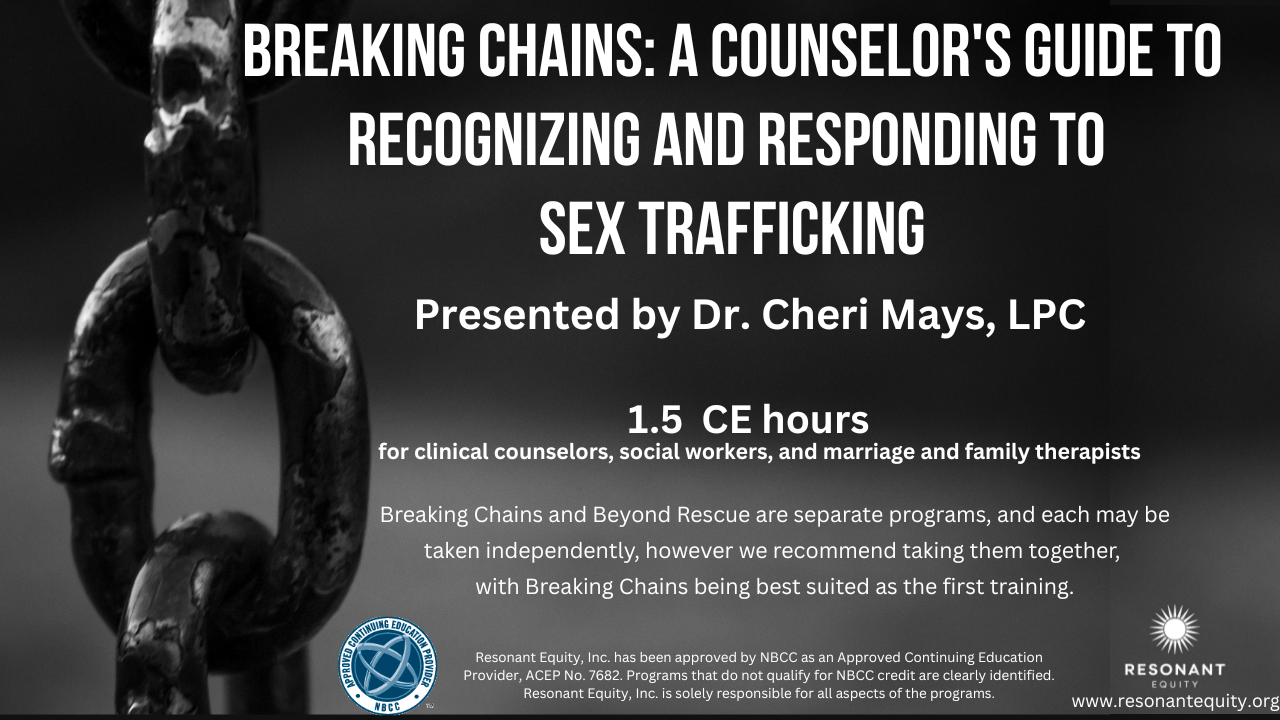
Breaking Chains: A Counselor’s Guide to Recognizing and Responding to S*x Trafficking – Part 1
- Intended for: Novice/Beginning Learners: No advance knowledge required
- NBCC Content Area: Human Growth and Development, Social and Cultural Foundations, Counselor Professional Identity and Practice Issues
- CE hours available: 1.5
Program Description
Please note: We’ve needed to say s*x in this event setup in order to hopefully make it through overzealous spam filters when sending emails to folks about this training.
This comprehensive course, “Breaking Chains: A Counselor’s Guide to Recognizing and Responding to S*x Trafficking,” equips counseling professionals with essential knowledge and skills to identify and support individuals who have survived sex trafficking. The curriculum covers the scope of this global issue, recognition of physical, behavioral, and environmental indicators, trauma responses in victims, and barriers preventing victims from seeking help. It emphasizes a trauma-informed approach to assessment and treatment, with specialized considerations for vulnerable populations such as children, international survivors, and LGBTQ+ individuals.
The course highlights the importance of collaborative care through strategic partnerships with legal services, housing providers, and survivor-led organizations while addressing the legal framework surrounding trafficking. It also emphasizes self-care strategies for counselors to prevent secondary traumatic stress when working with trafficking survivors. Throughout the program, participants learn that counselors play a vital role in victim identification and recovery through trauma-informed, culturally responsive interventions that acknowledge recovery as a non-linear process requiring appropriate support systems.
Part 2 is a continuation of this training. You may attend either or both trainings.
Learn more at www.antiracistcounseling.org/.
Educational Goals
This training presents comprehensive knowledge of s*x trafficking dynamics, including scope, impact, and the ability to recognize physical, behavioral, and environmental indicators in potential victims. Participants will gain proficiency in trauma-informed assessment strategies that create safe environments for disclosure while avoiding re-traumatization. The training is centered on evidence-based treatment approaches for trafficking survivors, including safety planning, trauma therapies, and addressing co-occurring conditions. Participants will learn specialized skills for working with vulnerable populations, including children, international survivors, and LGBTQ+ individuals. This training will support counselors in establishing effective collaboration networks with legal services, housing providers, healthcare systems, and survivor-led organizations, and understanding relevant legal frameworks, including the Trafficking Victims Protection Act, mandatory reporting requirements, and confidentiality considerations. This training will also share sustainable self-care practices to prevent secondary traumatic stress and compassion fatigue when working with trafficking survivors.
Learning Objectives
Upon completion of this program, participants will be able to:
- Identify at least five physical, behavioral, and environmental indicators of s*x trafficking victims in clinical settings to improve early detection and intervention capabilities.
- Discuss culturally responsive intervention strategies that address the unique needs of diverse trafficking survivors, including LGBTQ+ individuals, international survivors, and culturally specific healing practices.
- Implement at least three self-care practices to effectively manage secondary traumatic stress and compassion fatigue when working with trafficking survivors.
Equity Focus
This training advances equity in counseling by centering marginalized populations disproportionately impacted by s*x trafficking—including LGBTQ+ individuals, immigrants, runaway youth, and abuse survivors—while addressing the intersecting vulnerabilities that increase risk. The curriculum challenges power dynamics by exploring how trauma bonding mirrors societal power imbalances, teaching counselors to avoid replicating controlling therapeutic relationships. It decolonizes mental health practice through culturally specific healing approaches that move beyond Western-centric models, acknowledging diverse healing pathways across cultural contexts. By examining systemic barriers like immigration status, language limitations, and institutional distrust, counselors learn to navigate these obstacles rather than burdening survivors with overcoming them. The training provides specialized considerations for international survivors through immigration relief options and acculturative stress interventions while offering LGBTQ+-affirming approaches that counter historical pathologization of these identities. Additionally, by emphasizing collaboration with survivor-led organizations, the curriculum centers the lived experiences of trafficking survivors, shifting from expert-dominated narratives toward those with firsthand knowledge.
Presenters
Presenter Name: Cheri Mays, PhD (she/her)
Dr. Cheri Mays is an associate professor in the Department of Psychology and Counseling at Northeastern State University. She holds a Ph.D. in Counselor Education and Supervision from Oregon State University, where her dissertation focused on counseling trafficking survivors. As a Licensed Professional Counselor Supervisor and Clinical Certified Domestic Violence Counselor, Dr. Mays brings extensive experience in trauma-informed care to her work. Dr. Mays is an active member of the Global Association of Human Trafficking Scholars and the Oklahoma Coalition Against Human Trafficking, where she contributes to multiple workgroups, including Community Awareness, Education, and Training, as well as Youth Response. Her research on counseling competencies for working with s*x trafficking survivors has been published in the Journal of Human Trafficking, and she has presented her work at numerous international, national, and regional conferences. In addition to her academic work, Dr. Mays has provided direct counseling services to survivors of s*x trafficking in her private practice and as a volunteer with start-up organizations. She has also contributed to policy development, creating presentations for government leaders on the necessary policies related to human trafficking in Oklahoma.
 |
Resonant Equity, Inc. has been approved by NBCC as an Approved Continuing Education Provider, ACEP No. 7682. Programs that do not qualify for NBCC credit are clearly identified. Resonant Equity, Inc. is solely responsible for all aspects of the programs. |