Let's Talk About How to Talk About It: Using the Clinical Skill of Broaching

- Description
- Curriculum
- Reviews
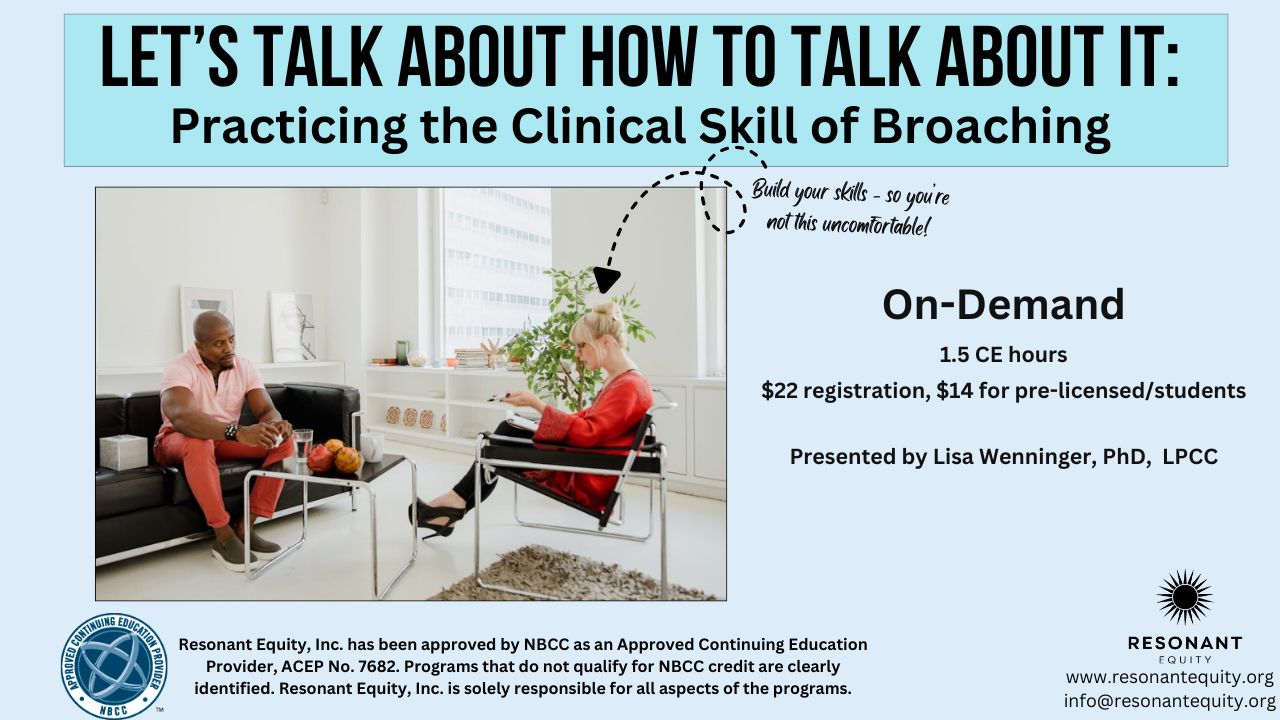
Let’s Talk About How to Talk About It: Practicing the Clinical Skill of Broaching
- Intended for: Novice/Beginning Learners: No advance knowledge required
- NBCC Content Area: Counseling Theory/Practice and the Counseling Relationship
- CE hours available: 1.5
Program Description
“I kept quiet because I did not want to alienate my client.”
How many of us have been reluctant to ask clients about difficult things? Maybe the client is defended, highly sensitive, avoidant, or just vulnerable and we want to protect them. We all learned how to ask about self-harm and suicidality during our graduate training as mental health professionals, and over time, develop that as a skill where it becomes practiced and natural. But what about taboo topics that our society has a tough time talking about? A critically important topic is race, especially if you’re a white counselor working with a client holding a different racial identity, and there are plenty of others too — like politics, in this age of extreme polarization. Does the concept of therapeutic neutrality get in the way for you to ask about these topics directly?
This workshop will offer a review of the clinical skill of broaching which you may have learned about in graduate school. If this skill is new to you, we’ll catch you up with its purpose and potential benefits. You’ll understand how broaching fits into culturally informed practices, and how it can help reset a power imbalance that may naturally occur in the therapeutic relationship. Broaching will be presented as a key skill within a social justice informed framework for clinically responding to our sociopolitical moment of 2026.
Participants will examine how principles of ethical responsibility and beneficence apply to broaching sociocultural and power dynamics in the therapeutic relationship, expanding on clinical models of risk broaching (e.g., suicidality) to include issues of oppression, privilege, and sociopolitical systemic harm.
Attendance at Resonant Equity’s prior Role of the Counselor training would be the ideal foundation for this skill-building workshop, however if you missed those trainings, no worries. There are no formal pre-requisites for this broaching skills workshop, and all interested mental health clinicians are welcome.
Please note: As part of this training experience, participants will be given the chance to practice skills using a video of a mock client. Those videos were created by AI. Resonant Equity recognizes the moral complexity of AI use. If you are strongly opposed to AI, we respect that, and suggest that this training may not be the right one for you. Registering for the training indicates your acceptance of this application of AI tools for the purpose of clinical skill development. All course content including the design of the learning objectives, this course description, and the slides was created by the presenter, Dr. Lisa Wenninger.
Educational Goals
This training offers a short how-to lecture on the rationale, purpose, and clinical application of broaching, especially in the context of cross-cultural counseling dyads and for sensitive or stigmatized topics such as politics, with the bulk of the training being experiential, where participants will practice the skill.
Learning Objectives
Upon completion of this program, participants will be able to:
- Describe the rationale and potential clinical benefits for broaching
- Explain the utility of broaching political topics as part of social-justice informed counseling
- Describe how broaching can be considered a decolonized practice in counseling
- Implement the clinical intervention of broaching appropriate to the client identity, culture, presentation, and circumstance
Equity Focus
This training shares the importance of cross-cultural broaching as the responsibility of the clinician as a power-sharing strategy in counseling.
Presenters
Presenter Name: Lisa Wenninger, PhD, MBA, LPCC/LPC/LMHC, NCC, BC-TMH (she/her)
Dr. Lisa Wenninger (she/her) has a PhD in Counselor Education and Supervision from Antioch University Seattle. She is a National Certified Counselor and is licensed in California, Washington, and Virginia, with a telehealth-only social justice counseling practice working with individuals with marginalized identities who are navigating a complex and difficult world. Dr. Wenninger serves on the Board of Counselors for Social Justice to promote advocacy and allyship within the counseling profession and help nurture development of the professional identity of counselor-advocate in colleagues. Dr. Wenninger makes a point to attend the meetings of the California Board of Behavioral Sciences and in other ways stay on top of laws and regulations affecting counselors and our clients. She regularly provides continuing education courses on topics such as law and ethics of telehealth, culturally informed diagnosing, and antiracism in counseling, and consults with organizations interested in building more inclusive and welcoming cultures.
 |
Resonant Equity, Inc. has been approved by NBCC as an Approved Continuing Education Provider, ACEP No. 7682. Programs that do not qualify for NBCC credit are clearly identified. Resonant Equity, Inc. is solely responsible for all aspects of the programs. |


Appropriate for all practitioner experience levels.